Monday, May 31, 2010

A line of poetry


On a warm breezy spring morning François Pilon heads out to the back lane. This is where he works, in yards and alleys all over the city.

"It's another world," he says of his alley turf. "The back lane doesn't appear on any map. There are no laws in this territory."

The way he talks about it, he sounds like an outlaw, but he's no criminal. He's a superhero of the Right to Dry movement.

He's Monsieur Corde à linge: Mr. Clothesline.

He wears blue work clothes, bright red suspenders and a headset so he can answer calls while he's two or three stories up his extension ladder.

His constant companion is Ricky, a quiet Doberman who waits in the truck or sniffs the perimeter of the yard while Pilon works.


In the back balcony of a 15-year-old building in Villeray, Mr. Clothesline looks around, sniffs and nods. "Condo lifestyle. No clotheslines, except for the person with young kids," he says, pointing to a line full of diapers.

He installs posts, ropes and pulleys all over the Montreal neighbourhoods of Mile End– where clotheslines are part of the landscape, Outremont, Villeray, Rosemont, Ville Emard, NDG, Montreal Nord, Ahuntsic, and even in Hampstead, where clotheslines are technically illegal because they're deemed unsightly.

Websites like laundrylist.org oppose municipal restrictions on line drying and advocate clotheslines as a way to save electricity and reduce emissions.

Last year, Monsieur Corde à linge put up 550 clotheslines.

It all started in the mid-80s, when he was working for a cable company and damaged a few clotheslines by grazing them with his ladder. He had to buy a length of rope and a few pulleys to repair the damage. That's when he noticed how precarious the laundry lines were. He'd found his vocation.


Before long he quit his day job. "I didn't want to die a cable TV guy. The pay is low, the hours are long and there's no security."

Today, as Monsieur Corde à linge, he works under essentially the same conditions, except he's his own boss.

"If I were doing it for the money, I'd do something else. I do it because I love being outside and I love clotheslines. The clothesline is my baby."

Francois Pilon's other baby is The Green Party. He's run in the Outremont riding in the last three federal elections. He was motivated by what he saw as collusion between government and the forestry industry.

"I got upset," he says. "I thought, OK. What do I do about it? Keep bitching? Or get involved." He doesn't expect to ever get elected, but says it's important that someone run for the Green Party in every riding, partly to push the other parties on their environmental agendas.

In the Villeray backyard, Caroline is happy to be Monsieur Corde à linge's first client of the day. "It's my third time using him over the years, because we keep moving," she says. "He's really busy! I called him weeks ago but he was booked up until now."

Pilon installs a five-foot post on her second floor balcony. Then he goes down the back spiral staircase and climbs his ladder to attach a hook and pulley to the Hydro pole in the corner of a yard. He dismounts and climbs the ladder again with a silvery clothesline in tow.

The day is perfect, the small orderly backyards are still, except for a few gardeners, a pregnant woman and the spinning drift of poplar fluff from a towering tree that provides a high canopy over most of the block.

"For me it's important to have a clothesline," Caroline says. "It's ridiculous to use a dryer when it's 30 degrees outside. And I love the poetry of a clothesline; there's something I like about seeing the diapers of the baby next door.

"Today I'm paying $250 for the best quality line and a good post on my balcony. Worth it! That's two hockey tickets and it will be good for years!"

While Monsieur Corde à linge goes out to his truck to write her bill, Caroline scrunches up her shoulders in anticipation. "I can't wait to do a load of wash. All I need is clothespins!"

She can't contain herself. She steps out on her front steps. "Hey!" she calls out to a neighbour. "I got a clothesline!"

A young guy, wearing New York T-shirt, looks at her and gives a blank nod, indicating that not everyone understands the poetry or the point of a clothesline.


"Women are my bread and butter," Pilon has told me, and judging from this exchange I can see why.

He hands Caroline her bill, and with it a complimentary packet of clothespins. "You've made my day," she tells him.

You might think a single guy in this line of work would get a lot of dates. But François says he maintains a professional distance and is careful not to mix business with his personal life. He always vousvoyers his clients. A bit of a performer, he likes to joke and do the odd stunt on a balcony railing (he says he only takes calculated risks and almost always wears a safety harness).

In a different yard a few blocks away he works with a helper, Gerald, to dig a hole for a new steel post to replace a rotting wooden one. The afternoon is boiling hot and François takes a break, instructing Gerald to "keep digging!" (-continue à creuser, toi!)

Out in the alley, he notices something and points. Behind the leaves of a climbing vine, it's his red and white sticker, two doors north of the yard he's working in today.

"I've been here before," he smiles with recognition. He's put up so many clotheslines in the past 18 years that the jobs and alleys all blur together.

"There's another one!" he pulls aside a leafy branch to show a pole across the alley bearing another one of his stickers: Montreal Corde à linge, with his telephone number and email.

As Caroline said, there's poetry in a clothesline.

Each one is particular, but somehow they all offer a ripple of hope.

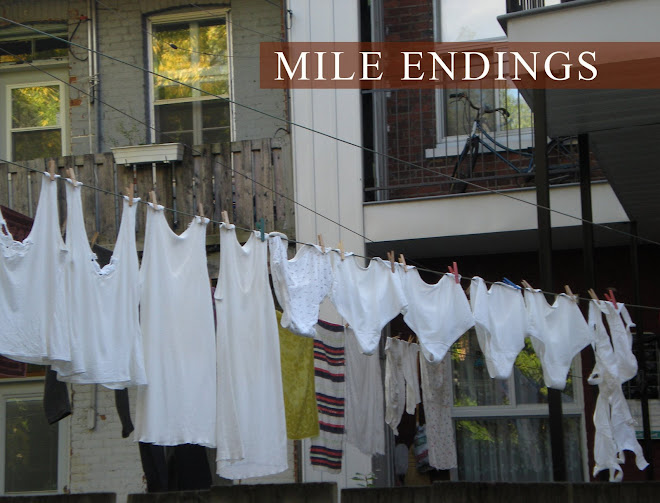
Undershirts. Bras. Pillow cases and flowered sheets. Diapers and tiny socks. Enormous panties billowing in the breeze.

Now when I see clothes waving on the line in my alley, I look for Monsieur Corde à linge's stickers. There's one now.

Monsieur Corde à linge Montreal
514-731-7261
email: francoispilon at sympatico.ca

Friday, April 23, 2010

Outside the box / hors de la boîte


There's something strange going on at the Videotron on Parc Avenue near Fairmount.

It's the people who work there, behind the mustard coloured counter, in their black Videotron Super Club polo shirts with gold nametags pinned to their chests.

They seem happy.

They open the doors for customers with strollers, look up a half-remembered title on the computer without condescension and then sprint out from behind the counter to show you exactly where to find it on the shelf.

They love movies. And, in contrast to the miserable, alienated employees in Clerks, or the music geeks in the record store in High Fidelity, they actually like working with the public.


"I love it when people ask my opinion," says Vincent Labrecque, 26, a budding director who watches two or three movies a day and can often be heard at the counter, rhapsodizing about a favourite, as customers punch in their rental code.

"The social part of the job is the best, talking to customers, recommending films," agrees Noémie-Anaïs Guichard, 27. She's worked at the store for 6 years and is the assistant manager.

"If she goes away for a few days, everything just falls apart," Vincent says.

Noémie-Anaïs shrugs modestly. The store may soon have to survive without her, as she hopes to get a job on a film shoot this summer. Her long-term goal is to find work as a script supervisor or camera assistant. "This store is a great place to make contacts. A lot of people in the neighbourhood work in movies," she says.


"The other day, our late list was like a Who's Who," echoes Vincent, who said he had to phone Denis Villeneuve (Polytechnique, 2009); Isabelle Blais (Les Invasions Barbares, 2003); and comedian Pierre Brassard about overdue DVDs.

Not that the movie rental business is all glamour. At the store they have to deal with shoplifters, and customers who want to fight instead of paying late charges. Vincent says he doesn't mind, the director in him likes learning the psychology of people, even if they get madder and madder.

He and Noémie-Anaïs have both had to deal with guys getting naked and whacking off in the adult video section. "We tell them to get out of there and go do that at home," Noémie-Anaïs explains calmly.

And still, they like their jobs.

For fun, and perhaps to expand the cinematic horizons of their clientele, Noémie-Anaïs and Vincent play obscure or forgotten films in the store and wait for customers to ask about them. Then, they make a pitch about why a certain film is worth seeing. "It's a classic of Québec cinema," she tells me while Les Ordres (Michel Brault, 1974) plays on the screens behind her.

Another day, Vincent exclaims, "It's beautiful! You can really see the influences of Truffaut and Goddard, and it's amazing to see Montreal at that time. Just look at the cars and there's Andrée Lachapelle, incredible!" He points to a blonde in a stylish convertible in YUL 871 (Jacques Godbout, 1966).
"Mine rented in 20 minutes!" the former film students will say to each other afterwards, competitive about how quickly they can get customers to fall under the spell of the footage and their spiel, and decide to take the film home.

You'd think cinephiles like this would want to work at a boutique video store like La Boîte Noire.

"The people who go to La Boîte Noire are already sold on what they want to see. I like seeing a wider spectrum of people watching films. I like finding out what people respond to," says Vincent.

He and Noémie-Anaïs take it upon themselves to watch kids' movies so that they know what to recommend to ten-year-olds, or parents. "Part of the job," they say.

They even have a relationship with some of the neighbourhood Hasidim. Really? "They rent kids' movies and comedies," Noémie-Anaïs reveals.

Less surprising than Hasidic Jews renting comedies, are the directors that Vincent and Noémie-Anaïs tell me are the most popular in Mile End: "Wes Anderson, Jim Jarmusch, Gus Van Sant, Almodóvar. " Right. As a typical neighbourhood resident, I've rented films by all of those directors from that store myself.

With all their passion and expertise, Vincent and Noémie-Anaïs will likely move on. They will be missed! But rather than dispensing movies, they'll be making them. They'll move way beyond nametags, and someday, we may find their names in a cinematic Who's Who.


Hors de la boîte


Il se passe quelque chose de pas ordinaire au club Vidéotron de l’avenue du Parc près de la rue Fairmount.

Ce qui est extraordinaire, ce sont les gens en polos noirs qui travaillent là, derrière le comptoir jaune moutarde.

Ils ont l’air heureux.

Ils ouvrent la porte aux clients encombrés d’une poussette, ils cherchent sans condescendance un titre à moitié oublié et se pressent de vous montrer où exactement le film se trouve dans les rayons.

Ils adorent le cinéma. Et, contrairement aux employés malheureux et aliénés du film Clerks, ou des mordus de musique du long métrage High Fidelity, ils aiment vraiment travailler auprès du public.

« J’adore quand les clients me demandent mon avis », dira Vincent Labrecque, 26 ans, un réalisateur en herbe qui visionne deux ou trois films par jour et qu’on peut entendre au comptoir faire l’éloge d’un film pendant que le client tape son numéro de code.

Le plus agréable dans ce travail, c’est la partie sociale ; parler aux clients, recommander des films… », renchérit Noémie-Anaïs Guichard, 27 ans. Elle travaille au Superclub depuis 6 ans et occupe à présent le poste de directrice adjointe.


« Si elle s’absente pendant quelques jours, tout s’écroule », nous confie Vincent.

Noémie-Anaïs hausse les épaules avec modestie. Le magasin devra sans doute survivre bientôt sans elle, car elle espère travailler sur un tournage cet été. Son but à long terme est de trouver un boulot comme scripte ou assistante à la caméra. « Cet établissement est un endroit fabuleux pour nouer des contacts. Beaucoup de gens du quartier travaillent dans le cinéma », nous dit-elle.

« L’autre jour, notre liste de retardataires ressemblait à un bottin du cinéma, ajoute Vincent en écho, lui qui a dû téléphoner à Denis Villeneuve (Polytechnique, 2009); Isabelle Blais (Les Invasions barbares, 2003); et le comédien Pierre Brassard pour des films en retard.

Mais l’industrie du DVD locatif n’est pas tout glamour, loin s’en faut. Au magasin, ils doivent aussi s’occuper des voleurs à l’étalage et des clients belliqueux prêts à se battre pour se soustraire à une amende. Vincent dit que ça ne le dérange pas, le réalisateur s’intéresse à la psychologie des gens, quand bien même ils deviendraient agressifs. Lui et Noémie-Anaïs ont tous les deux eu affaire à quelques occasions à des types qui se faisaient une branlette dans la section pour adultes. « Nous leur disons de quitter les lieux et d’aller se branler chez eux. » explique calmement Noémie-Anaïs.

Malgré ces incidents, ils aiment leur travail.

Pour s’amuser et peut-être aussi pour élargir l’horizon cinématique de leur clientèle, Noémie-Anaïs et Vincent font jouer des films oubliés ou méconnus et attendent que les clients se piquent de curiosité. Quand un client vient s’enquérir, ils leur expliquent pourquoi tel ou tel film vaut la peine d’être vu. « C’est un classique du cinéma québécois », leur dit-elle tandis que Les Ordres (Michel Brault, 1974) joue sur l’écran.


Un autre jour, Vincent s’exclame : « C’est magnifique ! On peut vraiment constater l’influence de Truffaut et de Godard. C’est étonnant de voir Montréal à cette époque. Voyez simplement les voitures. Et regardez Andrée Lachapelle. Incroyable ! » Il pointe du doigt la blonde en décapotable dans YUL 871 (Jacques Godbout, 1966).

« Le mien s’est loué en 20 minutes ! », dira l’un ou l’autre de ces ex-étudiants en cinéma qui font des concours pour voir combien de temps ça leur prend avant qu’un client tombe sous le charme et qu’il décide de ramener le film à la maison.

On pourrait penser que des cinéphiles comme eux préféreraient travailler dans une boutique comme la Boîte noire.

« Les gens qui vont à la Boîte noire savent déjà ce qu’ils veulent voir. J’aime voir un plus grand éventail d’amateurs. J’aime découvrir ce qui fait réagir les gens », dit Vincent.

Lui et Noémie-Anaïs visionnent même les films pour enfants afin d’être en mesure de faire des recommandations. « Ça fait partie du travail », disent-ils.

Ils ont même créé des liens avec certains membres de la communauté hassidique. Est-ce possible ? « Ils louent des films pour enfants et des comédies », nous révèle Noémie-Anaïs.

Ce qui surprend moins que des Juifs hassidiques amateurs de comédies, c’est le palmarès des réalisateurs les plus populaires du Mile End : « Wes Anderson, Jim Jarmusch, Gus Van Sant et Almadóvar », ont constaté Vincent et Noémie-Anaïs. Rien pour surprendre, car moi aussi j’ai loué à cet endroit des films réalisés par ces mêmes cinéastes.

Étant donné leur passion et leur expertise, Vincent et Noémie-Anaïs vont probablement se retrouver ailleurs d’ici peu. Ils nous manqueront ! Au lieu de louer des films, ils en réaliseront. On oubliera l’épinglette qui les identifiait. Un jour, c’est plutôt dans un dictionnaire du cinéma qu’on risque de retrouver leurs noms.

Wednesday, March 31, 2010

Exposure


This time of year, the days are longer and the extra light is surprising.

Winter ends, I go outside, and all of a sudden, I'm surrounded by neighbours. Spring conjures them up on the sidewalk.

I'm in my bathrobe, putting out the bag of dirty diapers, the green box full of wine bottles, or, later in the season, waving a shovel crazy-lady style at a cat defecating in the garden. Oh, hi.

In the winter, the cold makes everyone scurry home where long hours of darkness insulate us. Now, walking down the street is as revealing as taking a shower at the Y. Oh, hi, here we are, completely exposed.

It takes some adjustment.

In the face of all this light, I don't wear my glasses. Instant privacy. If I can't see the neighbourhood, it can't see me! I am regularly proven wrong, when blurry people wave at me and I wave back without knowing who they are.

But this willful myopia keeps the buzzing café across the street in its place, at a fuzzy remove.

That is – until I catch a glimpse of something interesting – like a couple actually getting married on the terrace outside Open da Night, or Thomas Fersen lining up for coffee, or neighbours I didn't even know were pregnant, out in the sun, with a brand new baby.

In that case, I run for my glasses and peer out the window, or better yet, rush right outside to get a good look.

Because, of course, I don't want to miss anything.

Sunday, February 28, 2010

February


This time of year, it feels like there is only slush and garbage and plastic bags windsocking in the trees.

Inspiration is hard to come by.

Last week I went to another city, another country. They do things differently there.

I felt like the world's last pedestrian, wandering through webs of parking lots, malls and chain restaurants. The emptiness was huge. No row houses, no stroller jams on sidewalks, no one flying through stop signs on bike.

It just wasn't crowded or dirty or slushy enough, either.

Good to be home. Even in February.


Wednesday, January 27, 2010

End of an Era


The sign in the window of Maple Leaf Hat and Cap Company reads, "Closing. Everything Must Go."

I can't believe it. I was in here just a month ago. Barry Shinder was sewing caps and telling me that business was slow.

He's being saying that since I first met him a year and a half ago, so it's a scenario I could comfortably imagine repeating itself for years to come. I would go in to buy gift caps and visit my favourite piece of living history (see original blog post) and Barry would be there, sewing away as he's been doing for his entire life.

But he's closing up shop.

The little factory on the first floor of the St.-Laurent triplex is more chaotic than usual. Bolts of fabric are heaped willy-nilly on the cutting tables next to half-sewn caps, boxes of brims and big juice jars full of snaps. Orange For Sale or Sold! stickers dot the old metal shelves and cabinets.

Barry Shinder's manufacturing costs became too high.

Last week his main client, the garment company who contracted him to make their caps, said they couldn't afford his prices anymore.

They offered him a job. So now, instead of sewing caps in the business his father started on the Main 80 years ago, Barry will commute to work in the Chabanel district and get paid a wage. No overhead, no staff (for years he's employed three workers during his busy season).

"I'll be a worker instead of a boss," he says. "I'm losing money here so anything I make will be better. It'll be money with no headaches!"


Barry Shinder doesn't look like a man without headaches. He's losing weight and sleep worrying about how he'll manage to get rid of everything, rent out his 1800 square feet of factory space, pay off his debts and change his life.

"I've never worked anywhere else. This is my whole life." Then he pauses and adds optimistically, "At least I'll get up in the morning knowing I have work. And imagine, an 8-4 job! Instead of seven days a week!"

He'll be bringing his dad's old Singer sewing machine with him to sew caps. "That is one thing I'd never sell," he declares.

While we're talking, the owner of a hat shop in Côte de Neiges comes in to scoop up some stock at reduced prices. Usually, he goes to a wholesaler where all the hats are made in China and sell for a maximum of $5 each. "Five dollars, and that's top quality!" he tells Barry. "A simple cap, like this," he says, picking up a cotton flat cap, "20 cents."

"But the plastic in that brim costs me 45 cents!" Barry objects. He turns to me and sighs. "There you have the whole story."

A triplex in Mile End is valuable real estate these days, yet Barry says he can't imagine selling. So at least there's that. The rows of sewing machines, the stacks of caps and the dust from decades of fabric-cutting will all be gone. And what will become of the shelves of old blocks he used for shaping caps? At least Barry will still be around.

"If I had to move out of this area it'd kill me," he says of the block where he's lived since 1953 when he was six years old. "I could walk around here blindfolded."

As I leave, wet snow is falling and I notice that just north of Barry's place, in what used to be a neighbourhood tavern full of battered wicker chairs, a fancy new bar has opened up. Change is everywhere. Everything must go.


link to original blog post on Maple Leaf Hat and Cap

Tuesday, January 19, 2010

Ode on a City Wall


I came to Montreal for the first time when I was 21. It was summer and I'd just spent a season planting trees in the bush, getting sunburned, blistered and bitten by blackflies.

The city was hot and steamy, full of traffic and bicycles. People crowded the parks and sidewalks and ate in restaurants that opened onto the street as if there wasn't enough room inside to contain so much life.

I ran through a sprinkler park wedged into the middle of a block of rowhouses, walked up and down the Main, bought beads in a shop by the bus station, drank the best coffee I'd ever had and ate things I'd never tasted before – Chilean avocado sandwiches and heart of palm salads. I was so hungry for all of it, for the whole city full of languages, the clatter of old Portuguese guys playing dominoes, the cold beer for sale at every dépanneur on every corner, the way people looked and talked and danced. I was in love.

I came back a year later. It was November. The city was frozen, snowless, bleak and ugly. I walked all over looking for traces of the things I loved. There were only grey streets, à louer signs in storefronts, barren rings of hockey rinks waiting for ice. Montreal was on the skids and I was without prospects, but somehow it was all exciting.

I got a job as a waitress and then as a reporter for a tiny newspaper that paid me by the column inch. At the top of my stories they misspelled my name. My roommate and I lived on reduced price cheeses from Vielle Europe and frozen perogis.

Our landlord controlled the heat in our cheap St.-Urbain apartment and it was the warmest place I'd ever have. I slept with my window cracked open; swaddled up in bed I could feel feathery snowflakes kiss my nose. We lit our kitchen and its ugly linoleum with a desk lamp and a string of fairy lights. Though the green shimmering Montreal I'd first met was nowhere to be found, it was still the early days of love. Nothing could get me down.


The "i love you..." graffiti makes me think of all this. The first time I saw it, I crossed the street to get a better look. It was on the no-man's-land of St.-Viateur East, low-down, close to the sidewalk. The writing was loopy, the way a schoolgirl would write in a diary. Later I saw that sometimes the i was dotted with a heart. The words are always followed by a pensive dot, dot, dot.

I ask people in the neighbourhood if they've seen this writing and they nod and smile, saying, "Oh yeah..." as if it reminds them of something, too.

A note scrawled on a garage door or on a bit of stucco close to the ground. It's like a little valentine. The words are seed bombs that guerilla gardeners throw into fenced-off vacant lots, planting flowers in the cracks in the concrete. Like the hearts that someone (the same someone?) is putting in the stop lights, the messages are surprise gifts, company in an unexpected place.

But who is this, "I", this "you" ? I wonder.

There's something wistful about the loopy writing. Maybe it's the dot dot dot that sends me back to that time back when I first loved the city, before I ever got my bike stolen, or my brakes stolen off my bike, or my handlebars stolen off my bike, before I ever got sick of bagels and waiting for the bus. Back when I used to go out late and come home later and we seemed to subsist on beer and ginger candies; when our Greek landlord greeted us shouting, "Beautiful girls! Beautiful girls!" The way he pronounced girls made it sound like he was complimenting us for having breathing organs like fish.

I take pictures of the graffiti, which really seems too sweet and gentle to call graffiti. I start a small collection.

But after a while the writing on the wall turns into one more familiar thing that I actually know nothing about, like the mystery of so many of my neighbours. Where does he go every day? Why does she leave the lights on all night? What are their actual jobs?

Then I notice the i love yous are fragile. When I go back and try to find them again, I discover they've been scrawled on top of or painted over.

That's to be expected, not much stands still, untouched. Bikes get stolen and my giddy infatuation has turned into something more complex. Yet in the noisy blur of snow plows and bike thieves, someone is out there, writing love on the wall, surprising us and triggering a thousand different thoughts with the words and the dot dot dot...


Friday, December 18, 2009

The Big Picture


Maclean stands on St.-Viateur with a clipboard and a pencil, peering across the street. He's an artist, but at the moment he's not making sketches, he's on a reconnaissance mission for Car-Free Mile End.

"I'm taking down the names of all the stakeholders," he says, as he notes the name and address of each business for future reference.

The sun is starting to go down, the light is bouncing off the buildings and seems suspended in the heavy air. It's warm for late November and there's been a smog warning every day this week.

The mild, sluggish quality of the day dovetails with Maclean's project, a community initiative designed as a local response to global warming and peak oil.

"I'm motivated by big picture issues," he says of his plan to get cars off St.-Viateur between Parc Avenue and St.-Urbain. "We have to do something."

Maclean is soft-spoken and never seems rushed, even though he's the father of a two-year-old son, paints in his studio three or more days a week, works at an art auction house, transports his family's laundry and groceries on a bicycle cart, plays ball hockey religiously on Sunday mornings and, now, spearheads a grassroots community group dedicated to opposing car culture.

"I used to want to design cars," he admits. As a kid in Winnipeg, he wanted to be an engineer. Although he's since changed directions, he never left behind the question, or the problem, of the car.


Maclean first started re-directing traffic on St.-Viateur about 9 years ago.

One summer morning we woke up to find the stop signs at the corner of Waverly transformed from "ARRET" to "ART."

Alternating letters were blocked out with red tape. It was so simple and striking that it was surprising no one had ever seen the art in the stop signs before. "People don't think about what surrounds them because they see it so often," Maclean told the newspaper at the time. "But my altering a stop sign just slightly makes them think twice."

Friend and fellow artist Billy Mavreas is prompt and pithy when asked to describe Maclean's work: "It's constantly evolving around a constellation of central themes – the Canadian landscape and road system."

In 2007, as a response to global warming, Maclean launched the satirical website kyotomotors.ca. He made tiny chrome magnets, perfect replicas of the "Legacy" or "Denali" tags on SUVs, except the names he covertly stuck on the backs of neighbourhood vehicles spelled: "Excess"; "Denial"; "Obligation"; and "Kyoto."

"I thought I could be the cheeky artist and put these Kyoto Motors magnets on cars and then say, 'OK, I've done my part,'" he says now. Over time, he realized that if he really wanted to close the gap between SUV drivers and cyclists, cynical gestures weren't helpful.

"Matt helped me see that," he says, referring to Mathieu Vick, cofounder of Car-Free Mile End.


At Café Olimpico on the first snowstormy morning of December, he and Matt talk global as well as local and vent their frustration over climate change deniers.

"Ultimately, peak oil will change things, whether people accept global warming as real or not," says Matt who is finishing a PhD in Astrophysics on the evolution of stars. "Instead of wasting 10 years debating whether it's real, we should act now! If we get cars off St-Viateur, it's going to help." Matt gives an edgewise glance and smiles, shaking his head at the notion of this small project as a remedy for a potentially doomed planet.

"It sounds ludicrous," concedes Maclean. "But the best case scenario to come out of Copenhagen is for people to ask, 'What's going to happen on the ground?' It's people who decide what their communities are going to do."

In the five months since they formed Car-Free Mile End, which has a core of six active members (including Zvi Leve, an urban transportation expert) and hundreds of fans on Facebook, they have created a blog, carfreemileend.blogspot.com, and a website, carfreemileend.com.

If you think the idea of getting cars off St.-Viateur is dreamy and unrealistic, have a look at the website FAQs: carfreemileend.com/faq.html. The answers are detailed and grounded in research. They explain the draw of a vehicle-free area for local businesses; make provisions for commercial delivery vehicles during certain hours; and cite the importance of avoiding a tourist-trap atmosphere.


And, if the notion of getting cars off a four-block stretch of one street seems like a local drop in the bucket, think about how cities will need to be rebuilt to adapt to life after peak oil. This is one of Nik Luka's main areas of study. He teaches architecture and urban planning at McGill. Matt and Maclean met with him to make their case and Nik Luka liked the idea. He's assigned a group of graduate students to study the potential of a car-free St.-Viateur and help survey locals.

Maybe this century-old, high-density, foot and bike-friendly neighbourhood can set an example and un-pave the way to carless, or at least car-light future.

To begin with, Car-Free Mile End plans to organize several festive, temporary street closures in summer 2010.

"It's not enough," says Maclean. "What's enough requires dismantling industrialized civilization. Rant, rant, rant," he adds, self-mockingly.


It may not be enough, but Maclean believes in the repercussions of individual actions. He refuses to own a car. He observes a self-imposed ban on flying. He dreams of putting "delivery by artist" in the contract so that when his dealer sells one of his paintings he can wheel it to the buyer by bike. And, he is "very much against pens" since finding out about the huge plastic (including disposable pens) trash vortex in the ocean.

In his studio full of tools and canvases and road signs, there are globes; the earth, the moon and stars. He's been painting the heavens, piercing vivid blue and orange tarps with grommets to form the shape of constellations.

He finds some solace in the grand scheme of the cosmos and the cyclical movement of planets around the sun.

Today, as snow whips by the window, he'll be working on one of his Dead End paintings, inspired by the black and yellow checkered sign that denotes the end of the road.

"It's the ultimate human predicament," he says, as he considers the checkerboard grid. "Whether it's personal, or the end of a whole civilization, it's like, Whoa. Slow down! a) you're going to die, b) you're part of something bigger."

The artist is here to signal us: our lives, our neighbourhood streets are part of the big picture. Stop. Proceed with Caution.


Links:
carfreemileend.com
carfreemileend.blogspot.com
kyotomotors.ca
rogerbellemare.com/maclean

Titles of artwork by Maclean above (not including work in progress in studio):
Untitled (ART - Hutchison and Van Horne), 2005
Northern Landscape, 2007
Winter Dead-End #1 and #2, 2005