Wednesday, November 3, 2010

What else is new?


From my front steps I can see someone dangling from a crane way high up, above St. Michael's highest cupola, easily eight stories high. They must be working on the very tip-top.

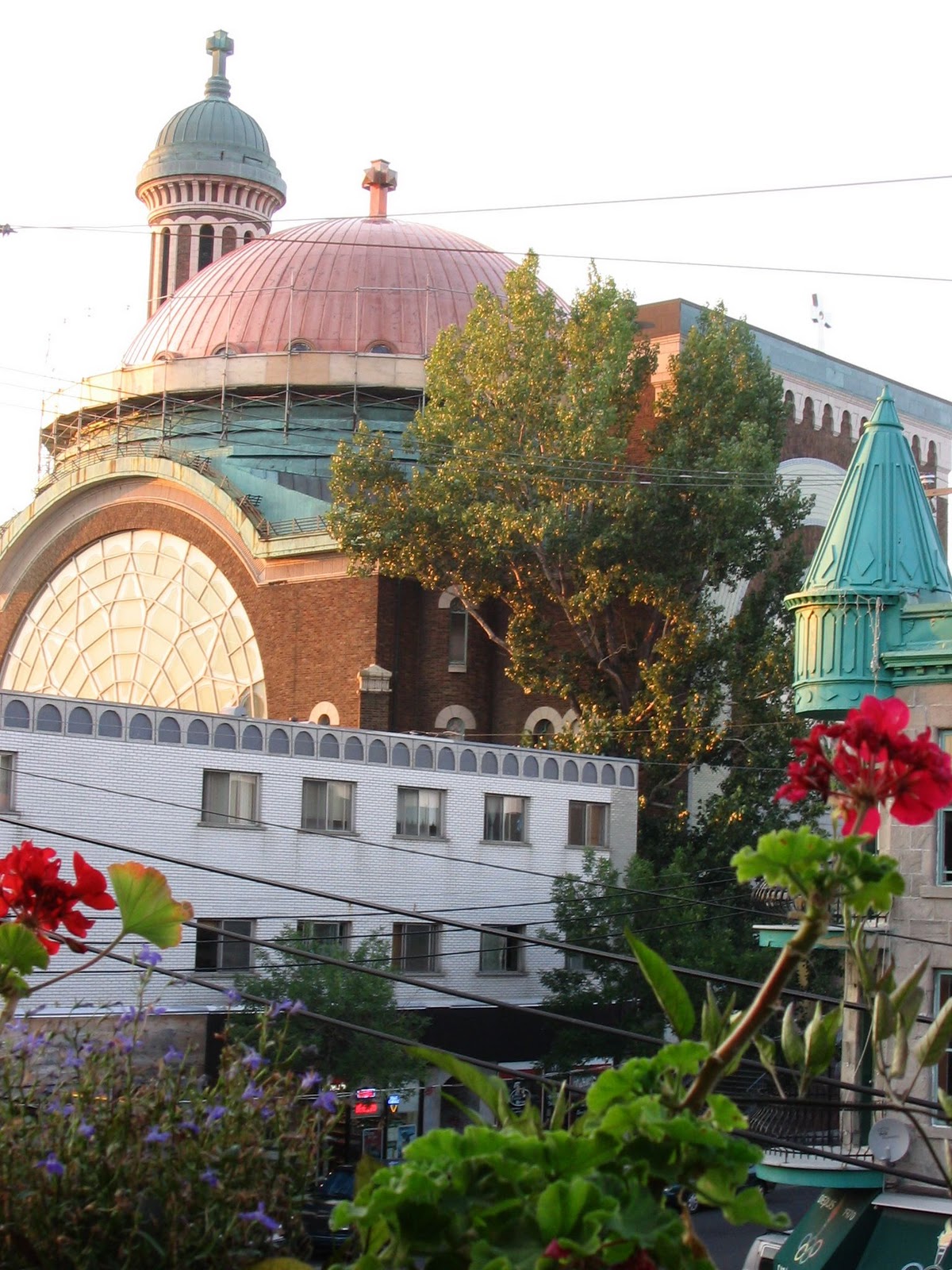
There was scaffolding up all summer as they restored the ribbon of copper edging on the west side of the church. A few years ago workers replaced the copper on the biggest dome, turning it into a giant peach that filled our front rooms with a rosy glow.

Already the big dome has dulled to the brown of a middle-aged penny. Before long, it will return to the pale lichen green of oxidized copper.

The other evening, the setting sun hit the church just so, lighting it up against a charcoal sky.

Every single person on St. Viateur seemed to pull out a phone or a camera to take picture. One man stopped, camera in hand, at our front steps and said, "Look at that. It's enough to make you religious."

I could have countered that a friend of mine once referred to the protruding shapes of St. Michael's as "the tit and the prick," an association I've never been able to quite forget, no matter what the light is like.


This week on every block the roofers' tarry vats boil away, filling the air with thick smoke like something out of Dickens. All the leaky roofs are being re-done before winter really hits.

At last, the sounds of construction pour out of the scuzzy bar at the corner of St. Viateur and St. Laurent.  Sometimes, when you wonder how long something can stay scuzzy, the answer is: longer than you might expect.

Walking down Casgrain from Bernard, I discover a giant new building adjoining a factory warehouse. I open the door. Inside it's thronging with Hasidic boys. Although I hadn't ever noticed it before, I asked and found out that the Académie Yeshiva Toras Moshe has been open a year already (and has lately been in the news).

I try to notice everything and remember it all. But I drift into my routine and daydream as I walk the same route everyday. Then, when I go out of my way by even one block I notice whole buildings have been razed to the ground since the last time I looked.

I happened to see the wrecking  in action at the old chicken parts processing centre on Maguire St. A bulldozer pulled metal window frames from the rubble and placed them in a pile. Good bye chicken parts. Hello condos.


Salaison Moe is also gone, the storefront kitty-corner from Wilensky's Light Lunch now for rent. What exactly did they did season behind the wicket in that mysterious place full of plastic barrels? Once I got a couple of used buckets for my compost there. They smelled of pickles.

Garage Bill on Clark Street is nothing but a hole in the ground. I'm sure it's better, fume-wise, not to have an auto body place on a residential street, but I had a soft spot for Bill, who once told me that wasn't actually his name, it belonged to the previous owner, he just used it for business purposes. But his wife had adopted it, and yelled out "Bill!" to get his attention and sometimes even called their son "Little Bill!"

At Riddell's on Bernard, renovations are underway. The hand painted sign, with the totemlike lure, the watery blue and the floating red maple leaves, is gone. Whoever moves in next it'll still be Riddell's to me.


Years ago, I went to Managua where directions were often given in relation to landmarks that had disappeared decades earlier. It was disorienting trying to find someplace that was supposed to be near the Cine Dorado which didn't even exist anymore.

I guess that's one way of preserving the past. These directions were like postcards from another time.

So, some things aren't the way they used to be. But certain spots are more vital now than within recent memory (see the tiny little falafel place or the itty bitty new fish and chip counter on St. Viateur). Some places seem like they're about to change, like Cabaret  Bar EXXX otica, on Park Avenue. Then it turns out they're just changing the lightbulb. And then, some things, like the giant shapes of St. Michael's, remain as vivid as ever.

Monday, October 18, 2010

Gone Fishing


On a recent rainy Friday, the door stood open at Riddell's Fishing Tackle at 55 Bernard St. West. People carried bags of lures and armloads of mounted fish heads out of the musty store.

I hadn't expect Mile End's most eccentric storefront to stay intact forever, but at the same time, it sort of seemed it should. It was a neighbourhood fixture, a dusty shrine to fish and fishing.

Just the other day, I'd walked past to see if the window display was still there. A young couple was looking at the spill of sand studded with lures and driftwood, and the mosaic of yellowed photographs and clippings taped to the glass.

"Wow!" they exclaimed at the discovery of this strange museum.

The store's owner, George Riddell, died in June at the age of 82.

Riddell taught himself to fish as a hungry kid during the Depression. He started his business on Bernard Street in 1960. The rent was $50 a month. For the next fifty years, it was his lair. There he sat, with an ever-present bottle of beer, making his lures, holding forth on fishing, and, after he'd made a big catch, it was where he dispensed free fish to neighbours who needed it.


Since the mid-seventies, it was his home, too. Rumour has it that one night when the store was broken into, the white-bearded Riddell, naked and yelling, chased the robbers out into the street.

Inside, it was obvious that I wasn't the only one who'd been keeping an eye on the place for the past few months. There were Riddell family members; friends, neighbours, and former customers; and a few wild-eyed collectors who used flashlights to comb the store's stock for treasure.

"We have to clear it all out by Sunday," said George's nephew Michael who'd flown in from England to help sort things out. "What could a dusty stuffed fish sell for?" he mused , shaking his head at a large specimen on the wall.

"He wasn't supposed to live here," George's niece Linda told me. She pointed to the store's tiny back room, the walls yellowed with half a century of cigarette smoke. "But he lived the life he wanted, and died the way he wanted."

She described her uncle as a loner, camper and fisherman who had a tough upbringing, and only completed grade two in school. As a kid, she saw him as a hero on a motorcycle. "He was artsy and had a sense of humour. You can tell by the stuff he made."


On the walls, George's hand lettered signs announced his handmade lures-cum-folk art: "Super Spin by Riddell" or "Blade Silver Old Time Troll by Riddell."

"We've all taken a few lures," said Linda. "Everybody in the family wanted one."

Riddell collected Asian and African face masks, possibly as a source of inspiration for the lures he made. He also stocked commercial lures.

"He made all the crazy looking ones," said Ottoleo who was wearing a necklace made of silver lures. "They're one of a kind. You'll never find them again. They have little fishy moves to them, he tested them in this tank."

A tank labeled "Riddell Lure Testing Tank" ran along one of the store's walls.


"He made that one out of a toaster," said Gaetan, Riddell's upstairs neighbour and friend, pointing to a squiggle of chrome.

Ottoleo, 23, said he caught his first fish at the age of three and used to come in to swap stories and tips with George. "He taught me how to make my own stuffed fish for mounting. You pack it with salt, set it in the sun. It works! I was going to bring mine in to show him, but he passed away. "

He filled up his knapsack, from which two newly acquired fishing rods protruded. "I'm so excited. Two hundred dollars worth of Riddell lures. This will last for the rest of my life!"

"He's a real fisherman so we're giving him a much better price than those guys," Michael told me, in a low voice, referring to the collectors. "Notice the fervent interest in the stuffed fish," he added dryly, as they remained unsold on the walls.

It seemed everything else was likely to be snapped up, including a press to make sinkers or weights for lures and old packets of made-in-France fish hooks.

This was a lot of activity for Riddell Fishing Tackle. The dark interior had attracted few visitors in recent years although one neighbour told me that despite his failing health, Riddell had opened the store on Saturday mornings until the end.

When I walked past the store, it never occurred to me that he was living in there, behind the closed door, in the dark.

Things have a way of changing, or disappearing, when you're not looking. That's when you realize you never paid enough attention while they were there.

I should have ventured in more than one time, on a summer afternoon about 17 years ago, when we bought lures to bring along on a camping trip.

A few days after the closing-out sale, the store windows stood empty except for a few pieces of wood. A new piece of paper taped to the window said: "Uncle George Riddell, 1928-2010. Thanks for the memories. Gone Fishing."

A couple days later, that too, was gone.


For more on George Riddell, see Alex Roslin's interview with him here.

Thursday, September 16, 2010

Bees in the hood


When Kathryn Jezer-Morton put up a beehive in a vacant lot (aka le Champs des Possibles) she wasn't sure what would happen.

She surrounded the hive with a small chicken wire fence and posted a sign introducing the hive's inhabitants as "peaceful, hardworking bees" with a caveat: "If you disturb them, they will sting you." For more information she provided an email address: mileendbeehive at gmail.com.

"I wanted an address without my name in it, in case of fines from the city," she laughs.

"My husband and I weren't sure how it would go. We thought, 'it's not on our property; it's a liability; people will get stung; vandalism will occur; it'll be removed by the city. But let's do it!' We put the little fence around it to deter dogs and night-time tagger kids."

After they set it up, Jezer-Morton worried about the hive getting damaged and about passersby getting stung. That night she couldn't sleep.

"Then I got a bunch of email – all from people who wanted to help!" she recounts.

"There was a bit of vandalism, people stole a few fence stakes. But I realized a hive is pretty much a self-protecting thing."


Walking down St. Viateur, Jezer-Morton manages to look light on her feet, even glamourous, at 40 weeks pregnant. She's on maternity leave from her job as an editor at an online men's magazine that she describes as "laddish" – nothing to do with nature.

It's a little hard to believe she's a beekeeper. Except she must be, because she says things like: "Working with bees is so calming. You have to be calm so they'll be calm."

Her grandfather kept bees in Maine, and she grew interested in keeping her own when colony collapse disorder first appeared in the news. She was living and volunteering in New Orleans where there was a post-Katrina renaissance in urban agriculture.

After moving back to her native Montreal and taking a beekeeping course in Mirabel, it made sense to find a spot for her hive near her apartment.

Two days past her due date, Jezer-Morton traipses through the hot field. She puts on her long sleeved gear and her bee veil and, in a move that seems like it might be one quick way of triggering labour, she opens up the hive.

She says she hasn't been stung once all summer, even though bees repeatedly got tangled in her long hair as she walked away from the hive and took off her bee veil.

In the shade of a factory building, in front of a wall covered in graffiti, her hive is filling up with honey. The bees have been working.

"I'm so excited this has worked out," she says. "Bees in a vacant lot. It's utopian!"


A few blocks away, not far from the railroad tracks, three more urban beehives are thrumming with activity.

Francis Miquet has been keeping bees in Mile End for five years, and first started beekeeping 15 years ago when he apprenticed with a beekeeper in Papineauville.

Since I happen to live with this particular beekeeper, I'm used to stepping around his box of bee stuff, the smoker, the scraper, the bee suit, and the extra empty hives. I admit, he's the one responsible for any preconceived notions I had about Mile End beekeepers (big hands with fingernails banged up and dirty; an old station wagon for hauling hives; a kitchen sticky in the fall from honey extraction).


I personally didn't used to believe it was a great idea to have a beehive in a neighbourhood packed with row houses and pavement and kids and only tiny gardens.

But I found out that cities are full of advantages for bees. They have a wider variety of trees and flowers than rural areas which are often dominated by one kind of crop and treated with pesticides. Bees can do well in a city as crowded and polluted as Paris and even manage to produce untainted honey.

I was also persuaded that honey bees are not aggressive and, unless you open up their hive, rarely sting. Unlike the wasps they're often confused with, bees aren't interested in people's food, or people.

People though, are definitely interested in bees. Due to popular demand, Projet Montreal is planning a pilot project for several Plateau beehives. Like keeping chickens, it's a form of urban farming that's capturing the imagination of city-dwellers all over the place.


At the edge of the vacant lot, Jezer-Morton's hive attracts spectators.

"We'd noticed honey bees in our garden and wondered where they came from," says Julia from nearby St. Dominique Street as she watches the action.

If you look, you may see them, too: bees on the job, they've been criss-crossing gardens of the neighbourhood, visiting the pear trees on Esplanade, the ferny plumes of cosmos on Waverly, and the Queen Anne's lace and clover along the railroad tracks.

see my other story on city bees, here.

Wednesday, August 18, 2010

Old school


This time of year, the shelves of Papeterie Zoubris are crammed with school supplies stacked as high as the towers of lemons at Fruiterie Mile End.

The stacks include fifteen thousand back-to-school scribblers that Jimmy Zoubris says he'll sell in the next few weeks.

I want one. I want them all. I feel the nostalgic pull of back-to-school Septembers. Fall doesn't offer the same kind of brand new beginning anymore, but at least there's still the fresh promise of an untouched notebook.

At Zoubris, alongside the piles of books and packs of pens, there are relics from another time. Racks of old transfer lettering to press onto paper, yellowing boxes of Ko-Rec-Type ribbon, and manual typewriters in a display case.

When I went away to university my parents gave me a new typewriter. It was an Olympia Report Electronic. Black and sleek it weighed as much as 10 laptops and purred when I turned it on. Its most amazing feature was a "correct" button that would lift errors off the page, collecting them on a spool of sticky white tape. If only all my mistakes could be so neatly gathered up and contained. Maybe I could find a spool of that correcto-tape at Zoubris.

There used to be more strange old things there. It was a sort of stationery museum. A friend of mine used to spend ages perusing boxes of archaic items such as assorted paper price tags on strings.

Jimmy Zoubris says now that the store occupies less space than it used to, they don't have room for much old stock, although he still likes to buy what he can at going-out-of business sales.

I say I miss seeing the older stuff on the shelves and Demetra Zoubris says: "You should see the basement!"

"You can't go in there" Jimmy says, reading my mind.

So I imagine it, a dim cave-like cellar packed with old ledgers, stacks of carbon papers, purple mimeograph ink and vintage Liquid Paper. There are floppy disks and dot matrix printer ribbons and the tiny doughnuts of reinforcements for looseleaf holes. It's a time capsule of all those little things we don't need anymore, things we barely noticed at the time, now obsolete.


my other story on Zoubris:
http://www.montrealgazette.com/business/Going+extra+mile+with+service/3352455/story.html

Thursday, July 8, 2010

Cymbals and pinwheels


At 9 o'clock on Sunday morning I heard the fanfare, loud and slightly wonky. It was coming closer.

They were back.

The Complesso Bandistico Italiano was marching along St. Viateur in honour of San Marziale.

I first heard them on my very first morning at the corner of St. Viateur almost 20 years ago after a long hot day of moving and a late night of unpacking. As it was then, the recurring crash of early-morning cymbals and the honking brass remained impossible to ignore.

Back then I looked out my window and saw a band made up of old men in uniform, with gold braid on their hats. The trumpet and trombone players had music clipped to their horns. Where did they come from? What were they doing here? And how much longer were they going to be making this noise?


While I still don't know all the answers, over the years I became familiar with the festival of San Marziale, the patron saint of Isca Sullo Ionio, the Calabrian birthplace of many Italian Montrealers who originally settled in Mile End, and then moved north to St. Leonard and Laval.

I learned that the early morning marching band was a prelude to the disco hits and Italian classics that another band would blast out from the stage on my corner. The decibel level of their renditions of "I Will Survive" and "Volare" was floor-shaking and ear-splitting, even with all my doors and windows closed.


There was always a ceremony in Italian for the saint, a blessing by the priest; folk dancing, and free pasta cooked up in huge vats on the patio of Café Olimpico.

The morning after San Marziale the street would be adrift with saintly raffle tickets that losers tossed to the wind late at night, once the winners of bikes and trips to Italy had been announced.

I turned into Old Sneep, the grumpy lemon-sucking character in the children's book Lentil who frowns on the festivity of a marching band. In my case, it was the throbbing sound system of the Italian wedding band that made me ornery. I would slam out of my door during "Dancing Queen," stepping impatiently around the families sitting on my steps eating pasta. I'd escape to a movie, careful not to come home until it was all over. Sometimes I went out of town to avoid the whole thing.

But this year, as I ate breakfast and heard the first faint oompah-pah it was different. My two-year-old daughter looked at me and said: "I want to go see the music."

So we went. There was a day-long spectacle on our doorstep, the perfect way to occupy a toddler from morning until night.


Was it just me, or was the disco band less deafening than usual? When we came inside for a break, I sang along to "Besame Mucho" and "Guantanamera." It was just one day, after all, why be annoyed?

We went back outside and in a thick cloud of smoke in front of The Social Club, we got a grilled Italian sausage. We ran into all kinds of neighbours and friends. We watched the final round of the marching band and then clapped and waved a pinwheel as kids whirled through Italian folk dances in bright vests and skirts.


The night was warm and gusty – made for pinwheels – and the street looked different. For a moment, old Italians had taken back the neighbourhood. They sat in lawn chairs, and observed the festivities, outnumbering groovy young Mile Enders.

As it grew dark and her bedtime came and went, Amelia kept looking at me. "Not go inside! Not go home!" she insisted, as if I were about to whisk her away from all the fun.

She was right, I might have, except there was no point trying to go to sleep at our place.

We lined up for the last batch of free penne with tomato sauce at 10:30. We ate it on a neighbour's dim stoop, half-way down the block where things were a little quieter.

Full of late-night pasta, she fell asleep during the raffle, the last event of the evening.


The next morning when we looked out the window, the Fernand Femia electricians were already pulling down the festive strings of coloured flags and lights. The Ville de Montreal was hauling away the portable stage. Festa di San Marziale, finito for another year.

I had a newfound appreciation for the marching band and blaring disco tunes, for the lights and crowds and vats of pasta. So the morning after felt a little like the day the Christmas decorations come down, the end of something special.

Wednesday, June 30, 2010

Mile End Line


At the north edge of Mile End a web of footpaths leads to the railroad tracks.

If you follow the paths to the chain link fence there's a hole, and if you step through that, you end up someplace else.

It’s quiet and the air smells sweet. Pink blossomed milkweed plants and a tangle of purple wildflowers mix with Queen Anne’s lace along the tracks that stretch into the distance.

It's a big, wide-open space –the opposite of an underpass. This is the scenic route to the other side of the tracks.

I used to haul my bike over the tracks all the time. I admired the way gaps in the fence always opened up, no matter how many times Canadian Pacific mended them to keep people out.

Then I heard about people getting tickets.

I sit down on a bench in the sculpture garden north of Van Horne, not far from the hole in the fence.


I meet a friendly dog, Kismo, and his owner Vito, who says he stopped crossing the railway when he heard about the ticketing. Then Vinnie and his young daughter Gabrielle wander by, but steer clear of the railroad. Vinnie got a warning from the CP police about crossing the tracks and says that’s enough to keep him out.

Mary was walking her dog Maggie across the tracks when the CP police stopped her. They said it was illegal, and that she could get killed.

"They did this whole what-if thing," she says. "'What if you tripped and hit your head, and a train comes. Then they gave me a ticket for $140."

Somehow, despite the ticket, she can’t stay away.

"It's a great walk, away from the sidewalk and I love the solidarity with other people who walk there. It's a little anarchist."


Some of the anarchist walkers are organizing. A group of citizens recently papered a section of the fence with signs that say: "Open/Ouvert." And now there's a petition demanding an end to ticketing and safe level crossings at the tracks (http://www.petitiononline.com/ouvert02/petition.html).


As I walk alongside the tracks, I don't run into any CP police, although I do see their signs. Danger. Private Property. No Trespassing.

There's not a lot of traffic on this line now, maybe a couple freight trains a day. I don't see any during my walk but I find a pigeon sliced in two by an earlier train. A reminder: if you’re going to be here you better watch out.


The sculptor Glen Lemesurier has a workshop that backs onto the tracks and he nods when I point out the bird. "They fall asleep in the sun on the warm tracks and don't wake up when the train comes," he says.

"Off the tracks, off Augie," Glen tells his son as they walk along the track with Bonnie Prince Billy, a husky-chow mix who's as energetic as his owner. "I don't want you ever to get in the habit of walking on them."

Augie is 10 and his dad has been working in his rail-side studio since before he was born. Augie has already spent years train spotting with his father's binoculars.

For his part, Glen seems to have reached an understanding with his neighbours at CP. He advises people to watch for the railroad cops and to not cross if they see them. But since he's not one to keep a low profile, his personal method of dealing with the rail authorities is based on a love of trains.


"The chef du chemin is pretty cool," he says. "I used to go down to the Outremont rail yards before they closed to get parts from old engines, brake pieces, nuts, bolts. I did 30 sculptures made from train parts."

Some of these are on display in his sculpture garden near the tracks, a Mile End landmark at Van Horne and Clark.


"The engineers used to stop the train and come into my workshop for a break," Glen says. "I'd talk to the switcher when there was one here. He was great, he gave me a lot of parts."

Striding through the tall grass along the tracks, he moves past the trees he's planted in the past few years. Forget about private property, he's a proud gardener as he points out willow, aspen, chestnut, sumac, white pine, poplar, pear, hemlock and cedar trees.


"In 10 or 15 years it'll be a forest," he says, picking a strawberry growing in the grass and popping it in his mouth.

His tree planting along the tracks makes me think of the parks some cities have made on old railway lines, like la Promenade Plantée in Paris or the High Line in Manhattan. But Glen's not waiting for the trains to stop running.

I sit on the bench in the sculpture garden in the shade of some poplars. A train thunders by with a long rumble. After that there's just the whoosh of traffic from the underpass and the sound of the breeze in the leaves.

Then, with a rustle, a person pops out of the hole in the fence, like a deer, or a rabbit. A few minutes later someone else comes through. They startle when they see me, but I'm not giving out any tickets, so they take the path by the sculptures made from the gears and rods and bits of old trains and continue on their way.


Monday, May 31, 2010

A line of poetry


On a warm breezy spring morning François Pilon heads out to the back lane. This is where he works, in yards and alleys all over the city.

"It's another world," he says of his alley turf. "The back lane doesn't appear on any map. There are no laws in this territory."

The way he talks about it, he sounds like an outlaw, but he's no criminal. He's a superhero of the Right to Dry movement.

He's Monsieur Corde à linge: Mr. Clothesline.

He wears blue work clothes, bright red suspenders and a headset so he can answer calls while he's two or three stories up his extension ladder.

His constant companion is Ricky, a quiet Doberman who waits in the truck or sniffs the perimeter of the yard while Pilon works.


In the back balcony of a 15-year-old building in Villeray, Mr. Clothesline looks around, sniffs and nods. "Condo lifestyle. No clotheslines, except for the person with young kids," he says, pointing to a line full of diapers.

He installs posts, ropes and pulleys all over the Montreal neighbourhoods of Mile End– where clotheslines are part of the landscape, Outremont, Villeray, Rosemont, Ville Emard, NDG, Montreal Nord, Ahuntsic, and even in Hampstead, where clotheslines are technically illegal because they're deemed unsightly.

Websites like laundrylist.org oppose municipal restrictions on line drying and advocate clotheslines as a way to save electricity and reduce emissions.

Last year, Monsieur Corde à linge put up 550 clotheslines.

It all started in the mid-80s, when he was working for a cable company and damaged a few clotheslines by grazing them with his ladder. He had to buy a length of rope and a few pulleys to repair the damage. That's when he noticed how precarious the laundry lines were. He'd found his vocation.


Before long he quit his day job. "I didn't want to die a cable TV guy. The pay is low, the hours are long and there's no security."

Today, as Monsieur Corde à linge, he works under essentially the same conditions, except he's his own boss.

"If I were doing it for the money, I'd do something else. I do it because I love being outside and I love clotheslines. The clothesline is my baby."

Francois Pilon's other baby is The Green Party. He's run in the Outremont riding in the last three federal elections. He was motivated by what he saw as collusion between government and the forestry industry.

"I got upset," he says. "I thought, OK. What do I do about it? Keep bitching? Or get involved." He doesn't expect to ever get elected, but says it's important that someone run for the Green Party in every riding, partly to push the other parties on their environmental agendas.

In the Villeray backyard, Caroline is happy to be Monsieur Corde à linge's first client of the day. "It's my third time using him over the years, because we keep moving," she says. "He's really busy! I called him weeks ago but he was booked up until now."

Pilon installs a five-foot post on her second floor balcony. Then he goes down the back spiral staircase and climbs his ladder to attach a hook and pulley to the Hydro pole in the corner of a yard. He dismounts and climbs the ladder again with a silvery clothesline in tow.

The day is perfect, the small orderly backyards are still, except for a few gardeners, a pregnant woman and the spinning drift of poplar fluff from a towering tree that provides a high canopy over most of the block.

"For me it's important to have a clothesline," Caroline says. "It's ridiculous to use a dryer when it's 30 degrees outside. And I love the poetry of a clothesline; there's something I like about seeing the diapers of the baby next door.

"Today I'm paying $250 for the best quality line and a good post on my balcony. Worth it! That's two hockey tickets and it will be good for years!"

While Monsieur Corde à linge goes out to his truck to write her bill, Caroline scrunches up her shoulders in anticipation. "I can't wait to do a load of wash. All I need is clothespins!"

She can't contain herself. She steps out on her front steps. "Hey!" she calls out to a neighbour. "I got a clothesline!"

A young guy, wearing New York T-shirt, looks at her and gives a blank nod, indicating that not everyone understands the poetry or the point of a clothesline.


"Women are my bread and butter," Pilon has told me, and judging from this exchange I can see why.

He hands Caroline her bill, and with it a complimentary packet of clothespins. "You've made my day," she tells him.

You might think a single guy in this line of work would get a lot of dates. But François says he maintains a professional distance and is careful not to mix business with his personal life. He always vousvoyers his clients. A bit of a performer, he likes to joke and do the odd stunt on a balcony railing (he says he only takes calculated risks and almost always wears a safety harness).

In a different yard a few blocks away he works with a helper, Gerald, to dig a hole for a new steel post to replace a rotting wooden one. The afternoon is boiling hot and François takes a break, instructing Gerald to "keep digging!" (-continue à creuser, toi!)

Out in the alley, he notices something and points. Behind the leaves of a climbing vine, it's his red and white sticker, two doors north of the yard he's working in today.

"I've been here before," he smiles with recognition. He's put up so many clotheslines in the past 18 years that the jobs and alleys all blur together.

"There's another one!" he pulls aside a leafy branch to show a pole across the alley bearing another one of his stickers: Montreal Corde à linge, with his telephone number and email.

As Caroline said, there's poetry in a clothesline.

Each one is particular, but somehow they all offer a ripple of hope.

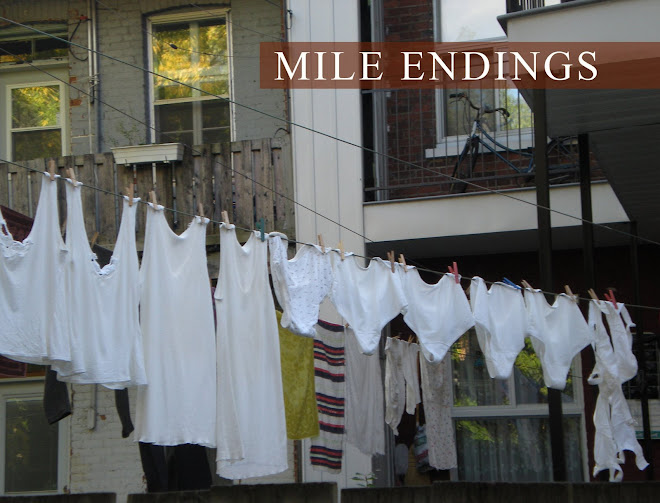
Undershirts. Bras. Pillow cases and flowered sheets. Diapers and tiny socks. Enormous panties billowing in the breeze.

Now when I see clothes waving on the line in my alley, I look for Monsieur Corde à linge's stickers. There's one now.

Monsieur Corde à linge Montreal
514-731-7261
email: francoispilon at sympatico.ca