Tuesday, January 18, 2011

It's so magic


Maybe if I wait long enough everything will come right here to Mile End.

My sister gave me a book called Big Ideas for my16th birthday and I have loved Lynda Barry ever since.

Lovers of Lynda Barry are ardent, loyal and extreme. They're given to walking away in disgust from people who say: "Those aren't even comics"; "Terrible drawing"; "Too hard to read, too much writing!"; or: "They're not even funny."

Lynda Barry can tell a perfect short story in four panels. It sends you spinning back to an exquisite, forgotten moment of growing up, and is gut-punchingly sad, funny and true in the same instant.

A few years ago, her work became hard to find. The comics were in fewer and fewer papers and her books stopped appearing. Where did she go?

Every once in a while I would Google: Lynda Barry + new book.


Then, one day, the answer came back from the ouija board of the internet:  Lynda Barry was back! In fact, she was practically moving into the neighbourhood. Mile End's own Drawn and Quarterly was her new publisher. I really felt like I was in on the action.

Last weekend, when Lynda Barry appeared in Montreal in person, there was a huge burst of adoring applause before she could even say a word.

She told jokes and stories, insisting it is our biological function to do so. It makes life worth living, she said. She talked about the power of images, busted dancercise moves and gave a slideshow. To quote her irrepressible character Marlys, she showed the audience "How to be an incredible #1 groover on life."


Mid-way through her talk Lynda Barry said, "In 2002 my publisher dropped me. It was over for me until Drawn and Quarterly came calling."

I looked around the packed auditorium of the Ukrainian Federation on Hutchison at Fairmount. Every (anglo) filmmaker, writer, artist and musician in the neighbourhood was there. It was a huge Mile End reunion and Lynda Barry was at the centre of it.

I hadn't known I lived next to hundreds of fans, people who would line up for three hours after the show to get their books signed. But it makes perfect sense. In a place where every other person has an art project or a film proposal in the works, a novel on the go or a demo in progress, Lynda Barry is the patron saint. And Drawn and Quarterly is the discerning, community-minded patron of the arts.


*

What it Is & Picture This by Lynda Barry
available from Drawn and Quarterly
211 Bernard St. West, Montreal
forthcoming, September 2011: the first in the new series EVERYTHING, previously published works and more, by Lynda Barry

Monday, January 10, 2011

Movin' on up


Jeans Jeans Jeans has moved out of the cave and up to street level but Borys Fridman doesn't want anyone to think they've gone high-end.

"We kept the floor as is," he says, indicating the faded white lines on the concrete floor of what was once a parking garage. "Not too fancy!"

The new store still feels like a warehouse but it's 2500 square feet bigger than the old basement. There's actually room to move between the racks of jeans.

Borys has posted arrows around the block pointing the way to the new spot on Casgrain north of St. Viateur. The placards are like the signs for a special event, or a movie set.

Jeans Jeans Jeans is its own scene.


The place is full of shoppers and toddlers, babies, boyfriends, moms and dads. The staff is running in all directions carrying armloads of jeans to customers and Borys seems to be everywhere at once, talking to everybody.

"It's crazy," he says happily. He finds my dad the perfect pair of jeans in 30 seconds.

"They're the best. They always come up with what we need," says one woman who's here from Laval with her husband on their semi-annual JJJ shopping trip.

There are more fitting rooms now, including a mom-sized one big enough to accommodate a stroller. There's an efficient new ticketing system for picking up your hemmed jeans at the circular counter where the cash register is.


But there's still nowhere to hide. There's the same stark fluorescent lighting and you still have to step out of the fitting room to see your jeans in the mirror.

And when you do, Borys and the Jeans Jeans Jeans staff will still look at you and declare: "You need to go a size smaller in those."

And, if you disagree, they'll still smile and shrug patiently, as if to humour you, even if they know better than you ever could about what is what in the world of jeans.

New place, same assertive service.

*

Jeans Jeans Jeans
5575 Casgrain

see original post on Jeans Jeans Jeans

Monday, January 3, 2011

On ice


I love finding something where I wouldn't expect it.

Like the lemon tree in the alley, the tiny backyard rink tucked in behind a row of greystone apartments on Clark Street is a perfect surprise.

The ice glows blue and smooth. Kids whirl, totter and scrape around the rectangle. The sound of skates slices the air.

"I'm like the Italians with their tiny gardens," says Tommy Groszman, master and creator of the rink. "I used to wonder, 'what are they doing with such a little space?' Now I'm like that with my little piece of ice."


Tommy built the rink for the kids, Ella and Adam, and also as a way of working through some ideas for a screenplay he's writing about hockey.

He figured out how to pack and water the snow at the edges of the rink so that water wouldn't run off. He created his own contraption for flooding the ice after consulting Home Zamboni videos on YouTube. His special rig involves a bucket fitted with a nozzle that attaches to a perforated tube. Bungee cords hold a square of carpeting in place for ice-grooming.

Some nights he gets up two or three times to make ice.

"It's addictive. My ice has to be perfect!" he says with a laugh. "I don't know if I should tell you this," he confesses, pointing to his boots. "But I'm not wearing any socks right now."

He is one with the ice this way, his feet alert to any stray bumps.


His perfectionism does not go unappreciated.

Ella, who is nine, can skate for hours on the rink right outside her back door. She zooms around in her hockey skates until bedtime.

"I'll miss it when it's gone," she says, projecting herself into the future and imagining her wistfulness, the way we do when something is truly special.

Wednesday, December 8, 2010

Page Turner


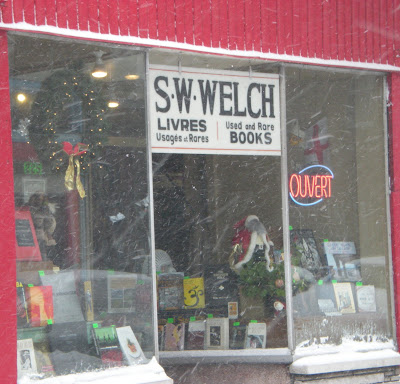
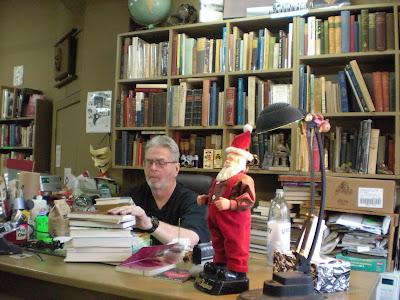
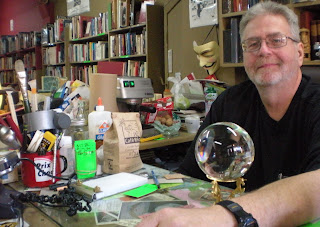
S.W. Welch is the oracle of St. Viateur Street.

Behind his counter stacked with books, he issues pronouncements: "Rebus will be back. I'll tell you that right now," he says of the detective  retired by author Ian Rankin. He also declares: "Harry Potter will be back."

Does he know something we don't?

The answer is, yes.

He keeps a luminous crystal ball on his countertop, but he doesn't need that to make his predictions.

On a recent weekday, the phone kept ringing and callers pressed him into instant evaluations. "I find it unlikely that that book would have much value," he tells one.

"It kills me when I tell someone their book is a piece of junk and they don't want to listen. I'm not the God of all bookselling but my opinion is that of one who's been interested in books for 30 years and has a fairly good idea of how much something's worth. It's a gut feeling based on years of experience. Then they'll say, 'is there anyone else I can call?'" S.W. Welch scoffs and shakes his head.

"I possess a certain amount of hubris and ego," he adds, with a smile.


"The general problem with being  a used or antiquarian bookseller is that people's books are infused with love and personal interest. Let's say you have a lot of books but you are, unfortunately, deceased. Your daughter calls me to look at the books, thinking, 'This one was on mom's bedside table for years. She loved it, she traveled to Egypt with it!' And then  S.W. walks in and says, 'I don't pay for sentiment.' "

Stephen Wesley Welch often refers to himself in the third person, as if to lend distance to his appraisal.  At 6 feet 6 inches tall and 340 pounds, his physical presence adds gravitas. "As a young man I was 165 pounds. You turn into a fat guy," he shrugs, blaming his sedentary occupation for his weight. "Once I started gaining weight I got more respect."


A customer who's been wandering around asks to see some art books from the window display. (Another S.W. decree: "Booksellers live by their windows.")

"We enjoyed our meal last night, Leo," S.W. tells him, after retrieving the books. "Next time, just maybe not so much oil on the octopus." The bookseller and Leo the restauranteur, trade goods for services, books for meals.

"You know how to be a millionaire as a bookseller?" Leo jokes. "Start with two million."

S.W. counters, "You want to run a small bookstore? Start with a large bookstore."

That's what  he did. The old S.W. Welch store on the Main was wider and deeper, with more room for books. But the Mile End space seems warmer. Three years after the move it feels like Welch's has been here forever, along with a permanent bunch of quiet browsers and a couch potato or two on the soft old sofa.

Someone comes in looking for Yann Martel's  "Life of Pee." A student in search of The Magic Mountain finds it on a table. Someone else inquires about a particular Asimov and someone else asks for Kitchen Confidential from the window.  Shoppers pay for paperbacks of Carl Hiaasen and Saul Bellow and a hardcover edition of George Steiner.


S.W. gets up to get books from the display, sits back down in the small space behind the counter and brews an espresso using the tiny machine wedged in at his elbow.

The countertop is littered with  the tools of his trade: a box of wipes, a mug of pencils, utility knives and brushes; a bottle of Elmer's glue.

The squeaky door admits a collection of regulars, including a boozy smelling guy who wants to sell CDs someone was probably throwing out. S.W. buys 20, saying, "I hope that's pure profit for you," even though he doesn't sell CDs in the store.

"He's one step away from being homeless," says S.W. who likes to support people who exist outside of the traditional economy,  such as the pickers who comb garage sales and church bazaars for books to bring him.

Every customer through the door comments on S.W.'s recent short haircut and beard trim. As a large white-whiskered man, he claims he sought it to avoid seasonal comparisons to Santa.

"I enjoy meeting people. But I'm actually quite shy," S.W. says.


Beany Peterson, S.W.'s wife of 35 years, confirms this revelation. "Stephen is shy to the point of..." she pauses as she searches for the right word. "He won't go to a party. He hates social functions."

She explains that the only way she got S.W. to agree to a party for her 50th birthday was to let him be the bartender. "If he can sit behind a counter with something to do, where people can come up to him, he'll have fun."

Behind counter at the store, S.W. says, "I'm in my comfort zone here. I'm in control."
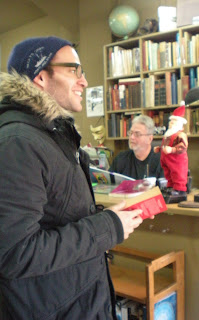
In his zone he chats amiably about Beany, a librarian at the Montreal Neurological Institute and a partner in the store; about their sons, Andrew and Patrick; about his family's house in New Brunswick; his grandfather's sardine cannery;  his preferred grocery stores and restaurants; how he's lost 80 pounds in the past year; what he's making for dinner (mussels tonight, slow roasted pork for tomorrow); fat-free Greek-style yogurt; photos he's taken lately; his camera; and, of course, books.

"I'm interested in every little tiny detail of every book," he says, pulling out a recently acquired, century-old paperback called:  Kenya: Britain's Youngest and Most Attractive  Colony. "This is just a goldmine of interesting stuff."

Yet, when someone comes in with a stack of books to sell, S.W. goes silent. All expression drains from his face. There are certain tricks to this trade.

"There's plenty of bluffing," he concedes. "The first thing about buying books is to show no interest whatsoever.  The books are just widgets  you're selling to widget buyers."

Of course this isn't true. It's the paradox of the whole enterprise.  As S.W. himself knows, people invest books with feeling. Sometimes books may be the only thing that makes life interesting.


One time, S.W. went to the small basement apartment of a man who'd worked in the laundry room of the Queen Elizabeth Hotel. He'd died and his mom was selling his books.

"This guy had everything," recounts S.W. "A complete set of Jung, Freud, Shakespeare. Everything. Every wall was shelved. He never cooked. He had a dictionary stand in the kitchen where he read his dictionaries. I told his mother I didn't have much money, that it wasn't enough, but I could give her $5,000 for it all."


At the store, a client pulls Dorothy Parker, ee cummings and Langston Hughes out of a knapsack. "Twelve dollars for these," is the verdict from behind the counter.

The shelves are packed, there are loaded carts of books and boxes on the floor, but the stock keeps coming in. "I'm not complaining," says S.W. "I'd spend my last penny on books."


Wednesday, November 3, 2010

What else is new?


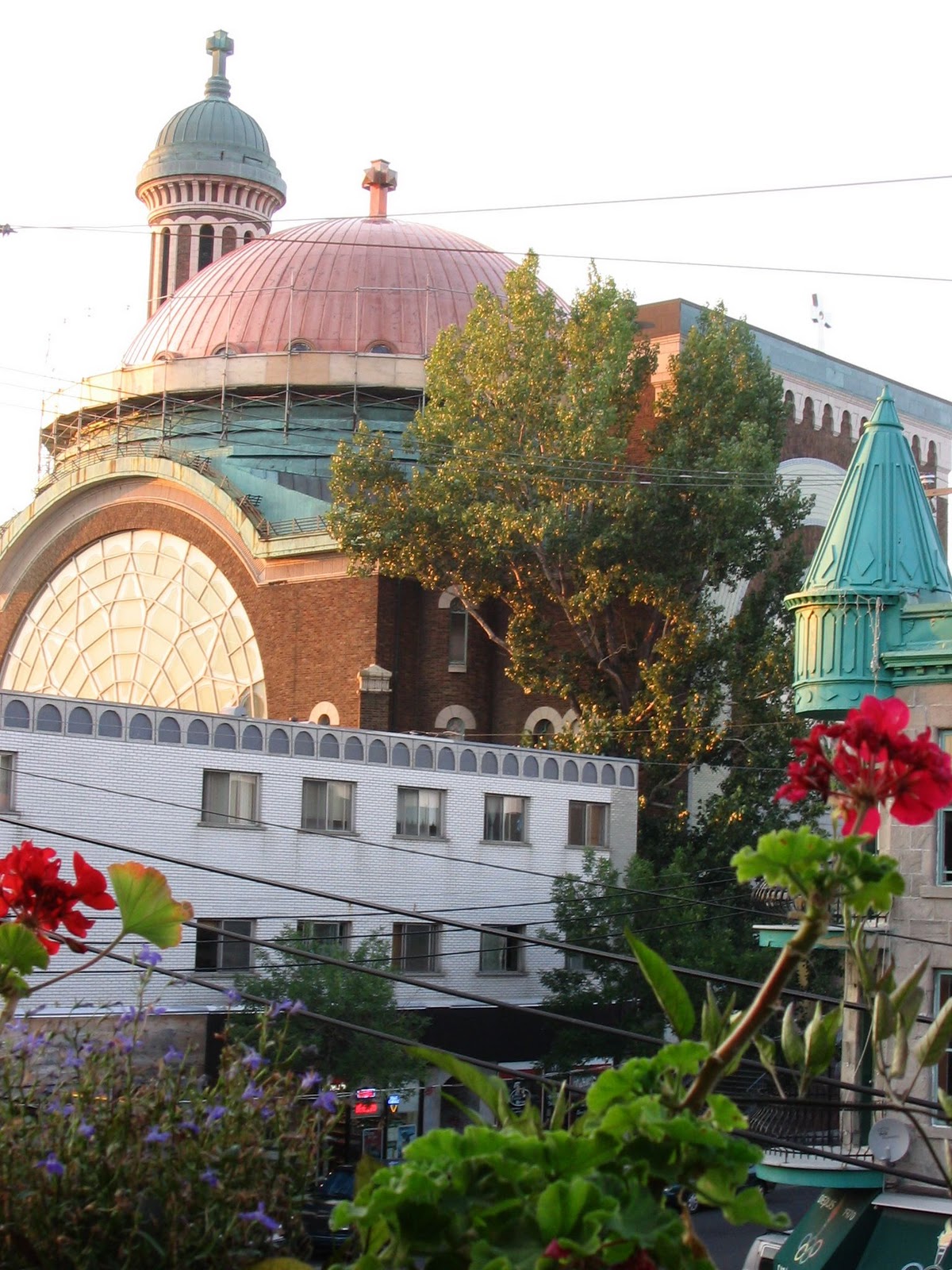
From my front steps I can see someone dangling from a crane way high up, above St. Michael's highest cupola, easily eight stories high. They must be working on the very tip-top.

There was scaffolding up all summer as they restored the ribbon of copper edging on the west side of the church. A few years ago workers replaced the copper on the biggest dome, turning it into a giant peach that filled our front rooms with a rosy glow.

Already the big dome has dulled to the brown of a middle-aged penny. Before long, it will return to the pale lichen green of oxidized copper.

The other evening, the setting sun hit the church just so, lighting it up against a charcoal sky.

Every single person on St. Viateur seemed to pull out a phone or a camera to take picture. One man stopped, camera in hand, at our front steps and said, "Look at that. It's enough to make you religious."

I could have countered that a friend of mine once referred to the protruding shapes of St. Michael's as "the tit and the prick," an association I've never been able to quite forget, no matter what the light is like.


This week on every block the roofers' tarry vats boil away, filling the air with thick smoke like something out of Dickens. All the leaky roofs are being re-done before winter really hits.

At last, the sounds of construction pour out of the scuzzy bar at the corner of St. Viateur and St. Laurent.  Sometimes, when you wonder how long something can stay scuzzy, the answer is: longer than you might expect.

Walking down Casgrain from Bernard, I discover a giant new building adjoining a factory warehouse. I open the door. Inside it's thronging with Hasidic boys. Although I hadn't ever noticed it before, I asked and found out that the Académie Yeshiva Toras Moshe has been open a year already (and has lately been in the news).

I try to notice everything and remember it all. But I drift into my routine and daydream as I walk the same route everyday. Then, when I go out of my way by even one block I notice whole buildings have been razed to the ground since the last time I looked.

I happened to see the wrecking  in action at the old chicken parts processing centre on Maguire St. A bulldozer pulled metal window frames from the rubble and placed them in a pile. Good bye chicken parts. Hello condos.


Salaison Moe is also gone, the storefront kitty-corner from Wilensky's Light Lunch now for rent. What exactly did they did season behind the wicket in that mysterious place full of plastic barrels? Once I got a couple of used buckets for my compost there. They smelled of pickles.

Garage Bill on Clark Street is nothing but a hole in the ground. I'm sure it's better, fume-wise, not to have an auto body place on a residential street, but I had a soft spot for Bill, who once told me that wasn't actually his name, it belonged to the previous owner, he just used it for business purposes. But his wife had adopted it, and yelled out "Bill!" to get his attention and sometimes even called their son "Little Bill!"

At Riddell's on Bernard, renovations are underway. The hand painted sign, with the totemlike lure, the watery blue and the floating red maple leaves, is gone. Whoever moves in next it'll still be Riddell's to me.


Years ago, I went to Managua where directions were often given in relation to landmarks that had disappeared decades earlier. It was disorienting trying to find someplace that was supposed to be near the Cine Dorado which didn't even exist anymore.

I guess that's one way of preserving the past. These directions were like postcards from another time.

So, some things aren't the way they used to be. But certain spots are more vital now than within recent memory (see the tiny little falafel place or the itty bitty new fish and chip counter on St. Viateur). Some places seem like they're about to change, like Cabaret  Bar EXXX otica, on Park Avenue. Then it turns out they're just changing the lightbulb. And then, some things, like the giant shapes of St. Michael's, remain as vivid as ever.

Monday, October 18, 2010

Gone Fishing


On a recent rainy Friday, the door stood open at Riddell's Fishing Tackle at 55 Bernard St. West. People carried bags of lures and armloads of mounted fish heads out of the musty store.

I hadn't expect Mile End's most eccentric storefront to stay intact forever, but at the same time, it sort of seemed it should. It was a neighbourhood fixture, a dusty shrine to fish and fishing.

Just the other day, I'd walked past to see if the window display was still there. A young couple was looking at the spill of sand studded with lures and driftwood, and the mosaic of yellowed photographs and clippings taped to the glass.

"Wow!" they exclaimed at the discovery of this strange museum.

The store's owner, George Riddell, died in June at the age of 82.

Riddell taught himself to fish as a hungry kid during the Depression. He started his business on Bernard Street in 1960. The rent was $50 a month. For the next fifty years, it was his lair. There he sat, with an ever-present bottle of beer, making his lures, holding forth on fishing, and, after he'd made a big catch, it was where he dispensed free fish to neighbours who needed it.


Since the mid-seventies, it was his home, too. Rumour has it that one night when the store was broken into, the white-bearded Riddell, naked and yelling, chased the robbers out into the street.

Inside, it was obvious that I wasn't the only one who'd been keeping an eye on the place for the past few months. There were Riddell family members; friends, neighbours, and former customers; and a few wild-eyed collectors who used flashlights to comb the store's stock for treasure.

"We have to clear it all out by Sunday," said George's nephew Michael who'd flown in from England to help sort things out. "What could a dusty stuffed fish sell for?" he mused , shaking his head at a large specimen on the wall.

"He wasn't supposed to live here," George's niece Linda told me. She pointed to the store's tiny back room, the walls yellowed with half a century of cigarette smoke. "But he lived the life he wanted, and died the way he wanted."

She described her uncle as a loner, camper and fisherman who had a tough upbringing, and only completed grade two in school. As a kid, she saw him as a hero on a motorcycle. "He was artsy and had a sense of humour. You can tell by the stuff he made."


On the walls, George's hand lettered signs announced his handmade lures-cum-folk art: "Super Spin by Riddell" or "Blade Silver Old Time Troll by Riddell."

"We've all taken a few lures," said Linda. "Everybody in the family wanted one."

Riddell collected Asian and African face masks, possibly as a source of inspiration for the lures he made. He also stocked commercial lures.

"He made all the crazy looking ones," said Ottoleo who was wearing a necklace made of silver lures. "They're one of a kind. You'll never find them again. They have little fishy moves to them, he tested them in this tank."

A tank labeled "Riddell Lure Testing Tank" ran along one of the store's walls.


"He made that one out of a toaster," said Gaetan, Riddell's upstairs neighbour and friend, pointing to a squiggle of chrome.

Ottoleo, 23, said he caught his first fish at the age of three and used to come in to swap stories and tips with George. "He taught me how to make my own stuffed fish for mounting. You pack it with salt, set it in the sun. It works! I was going to bring mine in to show him, but he passed away. "

He filled up his knapsack, from which two newly acquired fishing rods protruded. "I'm so excited. Two hundred dollars worth of Riddell lures. This will last for the rest of my life!"

"He's a real fisherman so we're giving him a much better price than those guys," Michael told me, in a low voice, referring to the collectors. "Notice the fervent interest in the stuffed fish," he added dryly, as they remained unsold on the walls.

It seemed everything else was likely to be snapped up, including a press to make sinkers or weights for lures and old packets of made-in-France fish hooks.

This was a lot of activity for Riddell Fishing Tackle. The dark interior had attracted few visitors in recent years although one neighbour told me that despite his failing health, Riddell had opened the store on Saturday mornings until the end.

When I walked past the store, it never occurred to me that he was living in there, behind the closed door, in the dark.

Things have a way of changing, or disappearing, when you're not looking. That's when you realize you never paid enough attention while they were there.

I should have ventured in more than one time, on a summer afternoon about 17 years ago, when we bought lures to bring along on a camping trip.

A few days after the closing-out sale, the store windows stood empty except for a few pieces of wood. A new piece of paper taped to the window said: "Uncle George Riddell, 1928-2010. Thanks for the memories. Gone Fishing."

A couple days later, that too, was gone.


For more on George Riddell, see Alex Roslin's interview with him here.

Thursday, September 16, 2010

Bees in the hood


When Kathryn Jezer-Morton put up a beehive in a vacant lot (aka le Champs des Possibles) she wasn't sure what would happen.

She surrounded the hive with a small chicken wire fence and posted a sign introducing the hive's inhabitants as "peaceful, hardworking bees" with a caveat: "If you disturb them, they will sting you." For more information she provided an email address: mileendbeehive at gmail.com.

"I wanted an address without my name in it, in case of fines from the city," she laughs.

"My husband and I weren't sure how it would go. We thought, 'it's not on our property; it's a liability; people will get stung; vandalism will occur; it'll be removed by the city. But let's do it!' We put the little fence around it to deter dogs and night-time tagger kids."

After they set it up, Jezer-Morton worried about the hive getting damaged and about passersby getting stung. That night she couldn't sleep.

"Then I got a bunch of email – all from people who wanted to help!" she recounts.

"There was a bit of vandalism, people stole a few fence stakes. But I realized a hive is pretty much a self-protecting thing."


Walking down St. Viateur, Jezer-Morton manages to look light on her feet, even glamourous, at 40 weeks pregnant. She's on maternity leave from her job as an editor at an online men's magazine that she describes as "laddish" – nothing to do with nature.

It's a little hard to believe she's a beekeeper. Except she must be, because she says things like: "Working with bees is so calming. You have to be calm so they'll be calm."

Her grandfather kept bees in Maine, and she grew interested in keeping her own when colony collapse disorder first appeared in the news. She was living and volunteering in New Orleans where there was a post-Katrina renaissance in urban agriculture.

After moving back to her native Montreal and taking a beekeeping course in Mirabel, it made sense to find a spot for her hive near her apartment.

Two days past her due date, Jezer-Morton traipses through the hot field. She puts on her long sleeved gear and her bee veil and, in a move that seems like it might be one quick way of triggering labour, she opens up the hive.

She says she hasn't been stung once all summer, even though bees repeatedly got tangled in her long hair as she walked away from the hive and took off her bee veil.

In the shade of a factory building, in front of a wall covered in graffiti, her hive is filling up with honey. The bees have been working.

"I'm so excited this has worked out," she says. "Bees in a vacant lot. It's utopian!"


A few blocks away, not far from the railroad tracks, three more urban beehives are thrumming with activity.

Francis Miquet has been keeping bees in Mile End for five years, and first started beekeeping 15 years ago when he apprenticed with a beekeeper in Papineauville.

Since I happen to live with this particular beekeeper, I'm used to stepping around his box of bee stuff, the smoker, the scraper, the bee suit, and the extra empty hives. I admit, he's the one responsible for any preconceived notions I had about Mile End beekeepers (big hands with fingernails banged up and dirty; an old station wagon for hauling hives; a kitchen sticky in the fall from honey extraction).


I personally didn't used to believe it was a great idea to have a beehive in a neighbourhood packed with row houses and pavement and kids and only tiny gardens.

But I found out that cities are full of advantages for bees. They have a wider variety of trees and flowers than rural areas which are often dominated by one kind of crop and treated with pesticides. Bees can do well in a city as crowded and polluted as Paris and even manage to produce untainted honey.

I was also persuaded that honey bees are not aggressive and, unless you open up their hive, rarely sting. Unlike the wasps they're often confused with, bees aren't interested in people's food, or people.

People though, are definitely interested in bees. Due to popular demand, Projet Montreal is planning a pilot project for several Plateau beehives. Like keeping chickens, it's a form of urban farming that's capturing the imagination of city-dwellers all over the place.


At the edge of the vacant lot, Jezer-Morton's hive attracts spectators.

"We'd noticed honey bees in our garden and wondered where they came from," says Julia from nearby St. Dominique Street as she watches the action.

If you look, you may see them, too: bees on the job, they've been criss-crossing gardens of the neighbourhood, visiting the pear trees on Esplanade, the ferny plumes of cosmos on Waverly, and the Queen Anne's lace and clover along the railroad tracks.

see my other story on city bees, here.